Available projects

Join us in figuring out who is who in a selected complex of cryptic species!

Work with part of the marine team at the University Museum in the project MADAM: Marine Amfipoder; Diversitet, Artskompleks og Molekylære studier / Species Mapping, Delimitation and Description – Cryptic Norwegian Amphipods

MADAM is an “Artsprosjekt”, meaning that it is supported by Artsdatabanken (NBIC).

The project home page can be found here: Artsprosjekt: Marine Amfipodar: Diversitet, artskompleks og molekylære studiar (MADAM) | Artsdatabanken

We study six families of amphipods, all of which have unresolved species diversity.
A master thesis connected to the project would work on one of the cases, using integrative taxonomy: detective work combining genetic data and morphological studies to figure out who is who.

Six amphipods on a black background
Our target families

Skills:
Learn DNA analyses,
Identification skills,
Field and lab work,
Scientific photography and drawing,
Potentially contribute on a scientific paper

Contact Anne Helene S. Tandberg if interested in discussing a thesis connected to MADAM.

This master project is linked to the Artsdatabanken-funded project Challenging taxa of gelatinous zooplankton (CHANGEZ). While a commonly observed dominant midwater hydromedusa in Arctic surveys, the trachymedusa Sminthea arctica (Hartlaub, 1909) is currently listed as a taxon inquirendum in the World Register of Marine Species (WoRMS). This is problematic, as the uncertain status of the species precludes it from being included in diversity assessments using WoRMS as the taxonomic backbone. This project will review the validity of the species Sminthea arctica, with the goal of resolving its status.

This MSc project includes:

  • taxonomic detective work on genus Sminthea
  • learning techniques in the DNA lab (DNA barcoding) and the morphology lab (identification and taxonomy)​
  • Phylogenetic and molecular species delimitation analysis
  • opportunitites to participate in field work
  • presenting in academic events and potentially being part of ​a peer-reviewed publication
  • inclusion in the Manet Team research group 🪼

Contact Aino Hosia, Luis Martell or Joan J. Soto-Angel to learn more about the project!

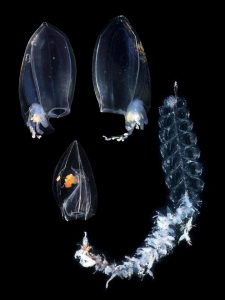
    Several species of calycophoran and physonect siphonophores are considered bipolar (Arctic and Antarctic). Pics by Joan J. Soto-Angel

    According to the literature, some siphonophore species occur in both polar regions and their corresponding neighbouring waters, but are they really the same species or not? How similar/related are they?

    This MSc project includes:

    • Sampling opportunities in the Arctic​
    • Learning techniques at the DNA lab (DNA barcoding) and the morphology lab (identification and taxonomy)​
    • Phylogenetic and molecular species delimitation analysis
    • Joining activities for outreach and science popularization​
    • Presenting in academic events and potentially being part of ​a peer-reviewed publication
    • Participation in European Project POLE2POLE (Horizon2020)​

    ​Interested? Contact Luis Martell, Joan J Soto Angel, or Aino Hosia